By: Darren Ell
Originally Posted on Upside Down World: September 2010
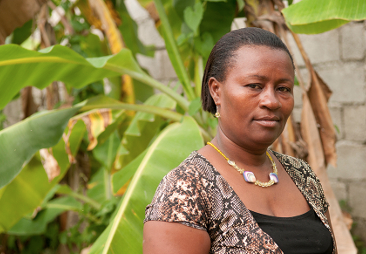
Rea Dol is the Director and co-founder of Society of Providence United for the Economic Development of Petion-Ville (SOPUDEP), a grassroots organization in Haiti offering education for children and adults and a micro-credit program for women. Her work in the aid effort following the January 12th earthquake in Haiti was the subject of a New York Times documentary. While in Haiti in July, Montreal freelance journalist Darren Ell asked her about the impact of the earthquake.
What happened to the community of Morne Lazarre, where your school, SOPUDEP, is located?
The community of Morne Lazarre was devastated by the earthquake. I was in the school when it happened and I cannot describe the horror around me. The school was empty and did not fall, but the neighbourhood collapsed. Five people were crushed to death just meters from me when one of the outer walls of the school grounds collapsed. My first responsibility was to my family, so I had to get home, but the streets were chaotic. People were panicking and screaming. I had to run home ten kilometres through those streets to find my family. The phones weren’t working. It was horrible.
In Morne Lazarre as in many areas of the city, it’s hard to say who died and how many because in many cases, the only people who knew who was in a house were the inhabitants themselves, and they died. Many are still under the rubble. Extracted bodies were rapidly buried, and now people are displaced throughout the city, so it’s impossible to get accurate numbers. We know Morne Lazarre intimately though. Three thousand people lived here prior to the earthquake, and we estimate that 65% of them died and 95% of their homes were destroyed.
How did the earthquake affect you personally?
On a personal level, when the earthquake happened, I couldn’t understand why I didn’t die. Where I was, many of the people around me died. It affected my profoundly, but I knew I had to overcome my feelings. I had to join in the struggle. I understood quickly that I had a mission. At first, I felt unable to offer support, but I had to do something, so I got a gallon of Betadine disinfectant and some gauze and went out into the street. I cleaned wounds wherever I could. After three months, I finally took a break. But during those first three months, I had boundless energy. So much needed to be done. I spent a lot of time in the camps with my staff and students. They really needed our solidarity. No other schools were doing this, going out into the city to find their people and reconnect with them.
I couldn’t have offered support to anyone with out the support of the Sawatzky Family Foundation (SFF), the Haiti Emergency Relief Fund (HERF), the Haiti Action Committee, special friends of SOPUDEP and individuals donating through the SOPUDEP website. They were always there for us. The work I did during the crisis built my credibility in the city as well to the point where people were consulting me on questions of the credibility of various organizations. But it was more than that. People began staying with me in my home! They kept coming and we cared for them, and we still do.
What has been the impact of the earthquake on education in Haiti?
25% of our schools were destroyed, 50% were seriously damaged and another 25% are standing, but staff and students won’t work in the buildings, so classes have resumed under tarps, but at least 50% of the students haven’t returned. Many died, and others have been dispersed throughout the city now in the tent cities, often far from their schools. It’s a very difficult time for education.
How has the earthquake affected the students and teachers?
We did an assessment of students after the earthquake. Some children who had an average of 80% prior to the earthquake scored 40%, a serious decline. There are several reasons for this. One is the living conditions they now find themselves in. When they had their homes, they could find a place to study, but in the camps, it’s hot and crowded in the tents. What’s more, kids are running around the camps all day, so students are distracted and can’t get their work done.
The trauma of the earthquake has diminished their capacity to retain information and learn. In April, when we reopened the school, we didn’t get into the regular curriculum at all. We did some cultural activities, sang songs and danced, but nothing else until May. We asked students to write about the earthquake. They all said it was the worst moment of their lives. They said they’d never recover from it. They added though that school was like medicine for them. Coming back to school was like life beginning again for them.
When we reopened, the teachers weren’t up to it. They were traumatized and asked for psycho-social assistance because they didn’t feel stable. Imagine how awful the students must have been feeling if the adults themselves needed help! We found a specialist in the city to help teachers get back to work. The assistance was successful, and yet when a truck rolled by and the school shook, it was total panic in the school and the teachers were the first ones out. We told the teachers they were supposed to be the last ones out of the classroom! They said, “We like our life too!” But I understood. They had to run. They were too traumatized. Everyone was.
After the quake, many teachers were living in very bad conditions. Some were sleeping in cars or public squares because they didn’t have tents yet. So we got tents for everyone so they could have some stability in order to work and prepare their classes. Today, six months after the earthquake, their situation has somewhat improved but it’s still difficult.
Many NGO’s were criticized during the earthquake. What was your experience of aid from large organizations?
The number of NGO’s in Haiti has ballooned again in Haiti. Are they going to change things fundamentally? We don’t think so. Without generalizing to all the cases, and without saying they haven’t helped, we believe they could do more. As far as organizations that could have helped SOPUDEP, there is Save the Children who sponsored a lot of organizations. They’re located right next door to us and they never helped us at all. They had a cash for work program for rubble removal, but I had to pay out of pocket to arrange rubble removal. When they finally came six months after the quake, they asked how they could help us and said they could fix the roof and clean out the toilets. But we didn’t see these as problems. We had more urgent needs related to our classrooms, but that assistance wasn’t there.
What we really needed – financial assistance – came from our regular donors and via our website. The big organizations offered only a small amount of material support: 100 tarps from the Red Cross, plus Save the Children eventually brought in some chalkboards and other school supplies. But the direct aid we gave to families, over 2957 families in 32 areas throughout the city, came from the SFF. It is the engine of SOPUDEP. With the SFF, we have a stable budget and we can plan. Teachers can also plan their lives now knowing there is a paycheck coming.
On a more global level across the country, aid was a disaster in terms of helping families. NGO’s decided to disburse assistance to women only. This led to the abuse of women. They would wait four hours under a hot sun, they’d get beaten by guards. This was shocking to us. They should have chosen Haitians to manage this. The voucher system for aid was abused. Vouchers were hoarded and given to friends while others got nothing. In the camps it was a mess. People with the vouchers were demanding sex for vouchers. Women’s organizations were very upset. Women’s desperation was being used as leverage for sex. What’s more, in order to get help, you had to demonstrate you were in absolute misery. How poor do you have to be to get help? For example, to get a tarp, you had to prove your ripped bedsheet was inadequate.
What does the near and long term future hold for SOPUDEP?
Our current school building is problematic. For years, we’ve received threats, sometimes armed, from a corrupt mayor. For this reason, we were already taking measures prior to the earthquake to find another location for the school. The earthquake made this move imperative. No one trusts the old building and the community is in ruins. We’ll be moving from Morne Lazarre to Delmas 83, quite far away, and this will cause problems for many of our students. Nonetheless, we want to offer all the help we can to keep everyone in our program.
We also want to help other schools in the area. Whenever we receive support, we offer supplies to other schools as well. SOPUDEP includes our main K-12 school, adult education, and a street children education program. We are reflecting on the problem of access to university as well, a huge problem in Haiti. We’ve received a proposal on this matter, and it could be an area for growth in the future. We have a larger vision in the field of health. Anything that represents a major roadblock for the population is where we put our energies. Another problem is unemployment, so we created a micro-credit program for women. Not being able to help your children yourself is awful, so we’re offering women the means to generate income and feed their families.
When we began, we had a small group of adults. It was a community organization that came together to discuss the problems of the country. While doing that, we saw more important problems. We started with activities for children every Saturday. Former President Aristide eventually integrated us into the field of literacy. Today, we have 58 people running our various programs. We are planning the construction of a new school, but our teachers need ongoing help for salaries. We also need assistance integrating our other projects into the SOPUDEP program: our micro-credit program and the elementary school in Boucan La Pluie neighbourhood.
We have grown a lot, but always one step at a time. It is very difficult to build organizations in Haiti. There are few means and we can’t know if we’re going to succeed. Things are shifting and changing all the time, and now things have been degraded to the lowest level possible. They say this is the poorest country in the Western Hemisphere. It doesn’t have to be that way. If we unite, a lot can happen. Working only for your own well-being will get us nowhere. Because of the terrible things that have occurred in our past, trust is an important issue. You absolutely need the trust of those around you in order to accomplish anything. What’s more, the systems in this country are deeply problematic and we need support and solidarity to change them.
What are your feelings on the reconstruction plan for Haiti?
The Government of Haiti should have taken the responsibility to rebuild many of the affected areas. Instead, construction was chaotic and anarchic with no oversight. As a consequence, people are currently living with significant physical dangers and many have already been victims of these dangers. The big question is: “Who is responsible for the reconstruction plan and will ordinary people be allowed to participate in it?” Thus far, we don’t see this at all.
An example is what we see across from the National Palace. This is the face of the country, a symbol of Haiti. And what do we see six months after the earthquake? Thousands of people living in absolute squalor in tents. Many people believe that reconstruction will not be possible with the current government, and many are concerned about who will be in the next government. Electing our own representatives is a sacred right and part of the solution we need. We are however in doubt about many things. Lavalas is there as a popular organization but there are several leaders, each one of them wanting to become the leader. Banning Lavalas from elections has only complicated things. What’s more, past choices were poorly done. For example, the people chose René Préval as someone who could represent them, but the opposite has happened.
Six months after the quake, nothing serious has been done. The first phase is over: everyone has shelter. We should have seen a second phase of more permanent shelters, but this hasn’t happened. The third phase should have been the rebuilding of the country, but we don’t see how this can happen with the current government. It’s abdicated it’s responsibilities. We’ve seen no results and I’m very concerned. Haiti needs to change. Otherwise, why would we keep working? All Haitians need to be very conscious right now, otherwise we won’t get anywhere.
Originally from Saskatchewan, Darren Ell is a teacher, photographer and freelance journalist residing in Montreal. Between 2006 and 2008, he documented the legacy of the 2004 coup d’état in online publication with the Citizenshift, The Dominion and Haiti Action. His photographic installation on this subject, Haiti Holdup, was exhibited at Concordia University in Montreal.
Photo © Darren Ell 2010