




Skip navigation.

Free and Accessible Education and Community Economic Empowerment

<<

SOPUDEP (Society of Providence United for the Economic Development of Pétion-Ville) is a Haitian founded and run grassroots social organization located in Port-au-Prince, Haiti. It provides free accessible education to adults and children, and supports women's rights and economic empowerment for the poor. SOPUDEP is determined to use the power of education to improve life for the poorest members of the community, creating pride and hope for a better future.

Learn More >>

SOPUDEP Updates

Sauvlyne's Hope: Haiti Two Years Later: January 18, 2012

Original version and posting at Sactuary for Kids

Photos by: Darren Ell

January 12, 2010, an earthquake ripped through the southwest end of Haiti, leaving thousands dead, and millions injured and homeless. The capital city of Port-au-Prince, with a population of 2 million living within 14 square miles, suffered the brunt of this quakes catastrophic effects. Over two hundred years since Haiti's independence, foreign exploitation of her citizens created a poverty that has wreaked havoc on the majority of the population. It was this chronic poverty and over population in Haiti's Capital that led to the devastating effects of this quake.


Those millions, who were left homeless, sought large open spaces to form makeshift camps.  These camps are cobbled together, using any materials on hand. Bed sheets, old tarps and scrap metal fashion homes that are so close together, people are virtually living on top of one another. These camps are stiflingly hot, increasingly dangerous for women and children, and have poor sanitation, with cholera spreading like wildfire.

All of these camps residents come from the poorer sect of society. Even before the earthquake, these poor majorities had little to no hope for employment or education, and now, have little hope to leave this deplorable living situation. Sauvlyne Louis Jean is a young woman whom I met in the summer of 2011; a student attending SOPUDEP School, a Haitian community school our foundation supports. She is a resident of one of these camps and was kind enough to let us see her world.

Building Community and Joy in the Struggle (Holiday Appeal); Dec 09, 2011

From 1791 to 1804, the African slaves of Hispaniola (now Haiti and the Dominican Republic) revolted against the mightiest imperial powers of the time, declaring their independence as the first western black republic. We owe them a great deal of gratitude for this act of rebellion and showing us that there is no power to great to truly snuff out our dignity and spirit of humanity. Sadly, those old imperial powers, and those new, have rarely shown respect for Haiti's sovereignty. "There's gold in them thar hills", to put it glibly. Our colonial past is one of taking from others what is not ours to take. This has proven to be a tough habit to squelch.

Haiti need to realize their ancestors dream of a free and independent nation. This can only happen if we release the reigns of control and put them in the drivers seat. In a country such as Haiti, where there are over 10,000 foreign charities and NGO's operating withing it's boarders, seeing local Haitian grassroots organizations taking action to empower their fellow citizens is special and should be nurtured.

SOPUDEP and other Haitian grassroots organizations are a prime example of the capability for Haitian's to make their own way; to educate, to work, to deliver justice, to preserve their proud culture, and to heal. It is up to us however, to show our support and solidarity, and at this moment in time, to provide the means to make their work more effective. There is an end goal with supporting Haitian grassroots social initiatives; not just a never ending money pit of "charity". The majority of Haitian's will be the first to say that they don't want handouts, but a chance to create a nation and a history that is theirs and theirs alone.

The Gift of Photography for SOPUDEP: Oct 2, 2011

Left: “After First Communion.” Upon finishing their first communion, Haitian girls pose upon leaving the cathedral in Cap Haitian. Right: “Smoke from Burning Tires.” Smoke fills a street in Port-au-Prince after security forces extinguish burning tires following a student demonstration against poverty.

By Darren Ell

I began working as a photographer in Haiti in 2006, a tense time in Haiti as the tumultuous period of the 2004 coup d’état was coming to an end.  Entire neighborhoods such as Cité Soleil were cut off from the world by UN troops, innocent people were being shot in the streets, and kidnappings plagued Port-au-Prince.  It was under these circumstances that American journalist and filmmaker Kevin Pina, with whom I had traveled to Haiti to work, introduced me to SOPUDEP Founder and Director Rea Dol.

Rea’s home was  (and remains) a hub for practical idealists.  Rea introduced me to independent journalists, well-informed political analysts, teachers and the many people who depend on her for shelter and advice.  She provided us with transportation for our journalism work and took care of our food and lodging needs.  I found her, and those around her, to have a profound knowledge of Haiti.  I soon found that she focused all this knowledge on  her main concern, a school named SOPUDEP, of which she was the director.

SOPUDEP and Haitian Grassroots, Sept 7, 2011


some other grassroots organizations that work along side of SOPUDEP. From left to right: Les Petits Amis de SOPUDEP, Fanm Viktim Leve Kanpai (FAVILEK) and Pax Christi Ayiti (PCA)

Some of you may have noticed, that a few months ago the website banner was changed from, "SOPUDEP School - Knowledge is not a privilege of power, but a right for everyone", to what is currently above, "SOPUDEP - a Haitian Grassroots Social Organization". "School" was dropped from the name, simply because working with SOPUDEP over the past three and a half years, I have seen SOPUDEP as an organization that address numerous issues that face the poor through different social programs. They needed to be promoted as such.

While they have mainly focused on providing education for both children and adults since the mid 1990's - including basic literacy, formal education, as well as cultural and health, education - they have tackled other social issues, such as disaster relief, integrating homeless children and those in servitude into a formal education system, and economic development (Micro-Credit). SOPUDEP, and namely founder/director Réa Dol, not only work within their own organization to provide for their community, but collaborate with and support many other Haitian social organizations throughout Port-au-Prince and beyond - as can be seen with Les Petits Amis de SOPUDEP and MOJUB. We all felt it was time to promote SOPUDEP as the multi-faceted organization it really is. To be fair though, their K-12 school remains their biggest project to date and continues to be at the top of their funding priorities.

Réa Dol to Distribute Potable Water to Camps - August 15, 2011

It has been a year and a half since the Haiti earthquake. Hundreds of thousands of her citizens are still displaced, living in the countless camps that now speckle Port-au-Prince and the surrounding area. The health and safety of those camps residents have yet to be ratified and water born illness, namely cholera, has tripled in the past few months. While everyone waits for development agencies, NGO's, local and international governments to organize and implement any kind of rebuilding effort, and for those billions of dollars in international pledges to show up, things like access to clean potable drinking water is still remains a top priority for preventing the spread of disease.

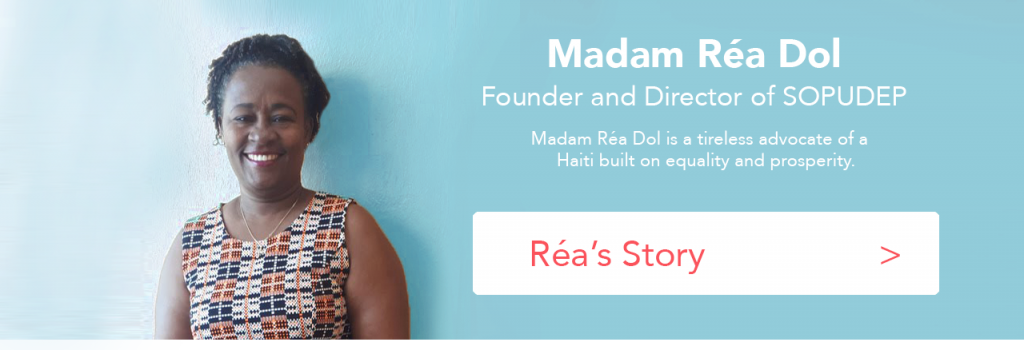
SOPUDEP Founder and Director Réa Dol never meant to fall into the realm of disaster relief, but as she has said time and time again, her life's mission is to help her fellow country men and women in whatever way she can. In addition to her fight for free and accessible education, economic development, and everything in between that seeks to empower the poor, she has been there for her people after any natural disaster. After the earthquake, Réa transformed her school and her home into a makeshift clinic and shelter, organized rescue parties and secured massive quantities of food that fed thousands of families for months.

Syndicate content